Jerusalem Goat Farm Self-Sufficiency Plan
A conservative, measurable plan to build the Jerusalem farm into a dependable income engine for Family Voice Ministries while allowing the farm to help finance its own productive expansion.
Mission
Build Jerusalem to generate at least $1,000.00 per month in net income for Family Voice Ministries. At current needs, that amount can support 10 orphans in private school and cover church expenses, including Pastor Musa's salary, allowing outside monthly support to be retained by Brothers for Christ for reserves or future growth projects.
Executive Snapshot
Aggregate data only. Planning assumptions are intentionally conservative and will be replaced by actual farm performance.
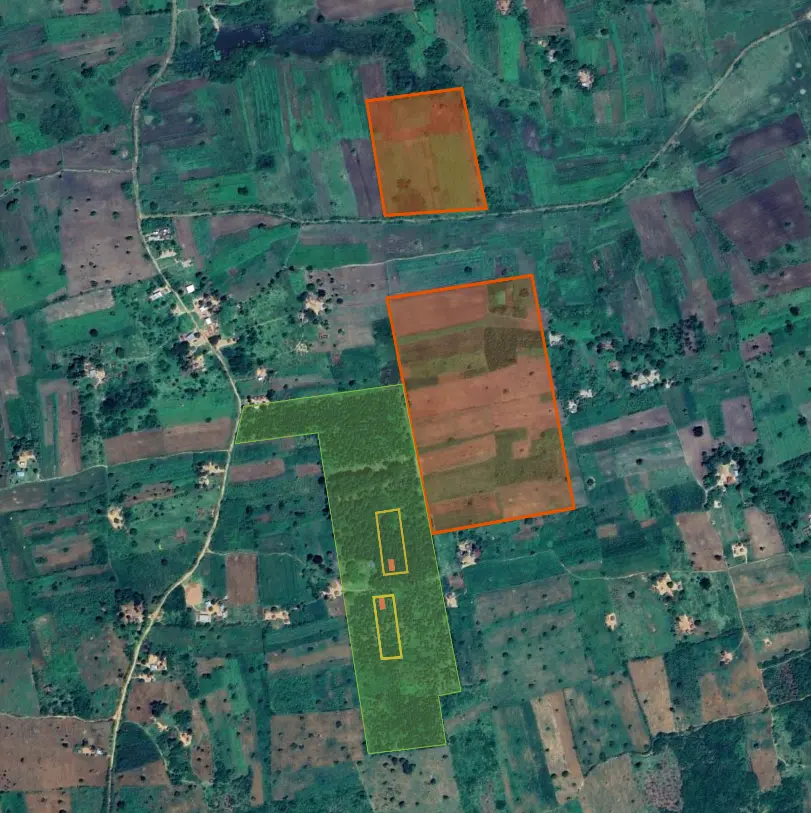
Two Farms on the Property—One Plan Shown Here
The land and livestock operation are divided into two separately owned farm sides.
Jerusalem · Family Voice Ministries
Jerusalem is the church and ministry farm. Its future net income is intended to support Family Voice Ministries, including education for the children and ongoing church expenses.
Jerusalem currently has one doe-and-kid house. Every housing number below applies only to Jerusalem.
Judea · Pastor Musa
Judea is Pastor Musa's farm side. Its herd, housing capacity and future profits are separate from Jerusalem's ministry plan.
The teams may share labor and some farm-wide operating purchases for now, but Judea's existing house is not counted as Jerusalem housing.
Jerusalem Project Focus
This view follows the ministry goat farm that Brothers for Christ is developing toward self-sufficiency.
Income-Producing Ministry Asset
Jerusalem is being built as a productive asset for Family Voice Ministries. Future Jerusalem net income is intended to support the ministry's ongoing work rather than require permanent outside operating support.
Measured Self-Sufficiency Goal
The target is at least $1,000.00 per month net from Jerusalem. The plan measures productive does, births, mortality, sales, realized prices, operating costs and housing capacity against that outcome.
Growth Capital With a Purpose
New breeding stock and housing are staged according to Jerusalem's productive capacity. Early expansion may require BFC bridge funding; later livestock sales are expected to fund an increasing share of infrastructure.
Accountability Over Time
The August 22, 2026 assumptions are preserved as a dated baseline. Future plans will be appended with actual farm results so supporters can see where projections proved conservative, optimistic or accurate.
Why the Plan Uses 197 Productive Does
The model works backward from the ministry income requirement; housing is planned with additional physical capacity.
Dated Economic Assumptions
| Conservative selling price | $85.00/goat |
| Breeding-stock purchase ceiling | $120.00/goat |
| Steady-state saleable goats | 1.0/doe/year |
| Jerusalem annual operating allowance | $4,704.00 |
| Annual net income goal | $12,000.00 |
| Gross revenue needed | $16,704.00 |
Working Target
The current mathematical threshold is approximately 197 productive Jerusalem does, so the working income target is 197. Seven Jerusalem doe houses provide planned room for about 210–224 adult does, leaving physical space above the financial threshold. Actual sales and costs must still be measured because the income projection is not guaranteed.
Live progress: 26 / 197
Projected Sales and Net-Income Capacity
Steady-state model after ordinary replacement females are retained.
Gross Annual Sales
The rust line marks the $16,704.00 gross requirement used in the dated plan.
Planning Net After Operating Share
Gross sales less the dated $4,704.00 Jerusalem annual operating-cost allowance.
| Productive Does | Saleable Goats/Yr | Gross/Yr | Planning Net/Yr | Position |
|---|---|---|---|---|
| 50 | 50 | $4,250.00 | -$454.00 | $12,454.00 short |
| 100 | 100 | $8,500.00 | $3,796.00 | $8,204.00 short |
| 150 | 150 | $12,750.00 | $8,046.00 | $3,954.00 short |
| 175 | 175 | $14,875.00 | $10,171.00 | $1,829.00 short |
| 190 | 190 | $16,150.00 | $11,446.00 | $554.00 short |
| 197 | 197 | $16,745.00 | $12,041.00 | Meets goal +$41.00 |
How Goat Sales Can Help Pay for Expansion Without Slowing Female Growth
The key is to protect the females needed for growth and sell the market-ready males. The 53-goat figure is a worked financing example, not a requirement to sell 53 breeding animals.
Male Sales Toward One $4,500 House
Conservative growth illustration: one surviving kid per productive doe per year, about 50% male and 50% female. Quality females needed for expansion are retained.
Worked Example: 106 Productive Does
If Jerusalem reaches 106 productive breeding does, the conservative model assumes about 106 surviving kids during one annual production cycle.
| Approx. male kids | 53 |
| Approx. female kids | 53 |
| Sell 53 market-ready males at $85.00 | $4,505.00 |
| Projected next-house budget | $4,500.00 |
| Quality female replacements sold for the house | 0 |
How BFC's Bridge Requirement Can Shrink as Jerusalem Grows
These are planning illustrations using the same conservative assumptions. Actual births, survival, sex ratio, sale timing and prices will vary.
| Productive Does | Surviving Kids | Approx. Males Sold | Approx. Females Retained | Male-Sale Gross | House Funded | Approx. BFC Bridge |
|---|---|---|---|---|---|---|
| 50 | 50 | 25 | 25 | $2,125.00 | 47% | $2,375.00 |
| 75 | 75 | ~38 | ~37 | $3,230.00 | 72% | $1,270.00 |
| 100 | 100 | 50 | 50 | $4,250.00 | 94% | $250.00 |
| 106 | 106 | 53 | 53 | $4,505.00 | 100% | $0 |
Do Not Wait Until 106 Does to Start Building
The house must be ready before retained young females create overcrowding. Using the current planning capacity of about 38 adult does per house, the next house should be planned when existing houses average roughly 30–32 adult does, or sooner if retained doelings will push the herd beyond comfortable capacity before the next construction window.
That means BFC may sometimes front or bridge the construction cost first. Male-sale proceeds from the coming production cycle can then offset that cost or refill the Jerusalem Growth Reserve.
The Economic Lesson
At an earlier stage, the farm may generate only part of a house cost. For example, at about 50 productive does, selling approximately 25 market-ready males at $85.00 produces about $2,125.00. Instead of BFC automatically paying the full $4,500.00, the farm contributes what it has produced and BFC bridges the remaining approximately $2,375.00.
As the herd grows, the farm's contribution rises until a production cycle can potentially finance an entire house itself.
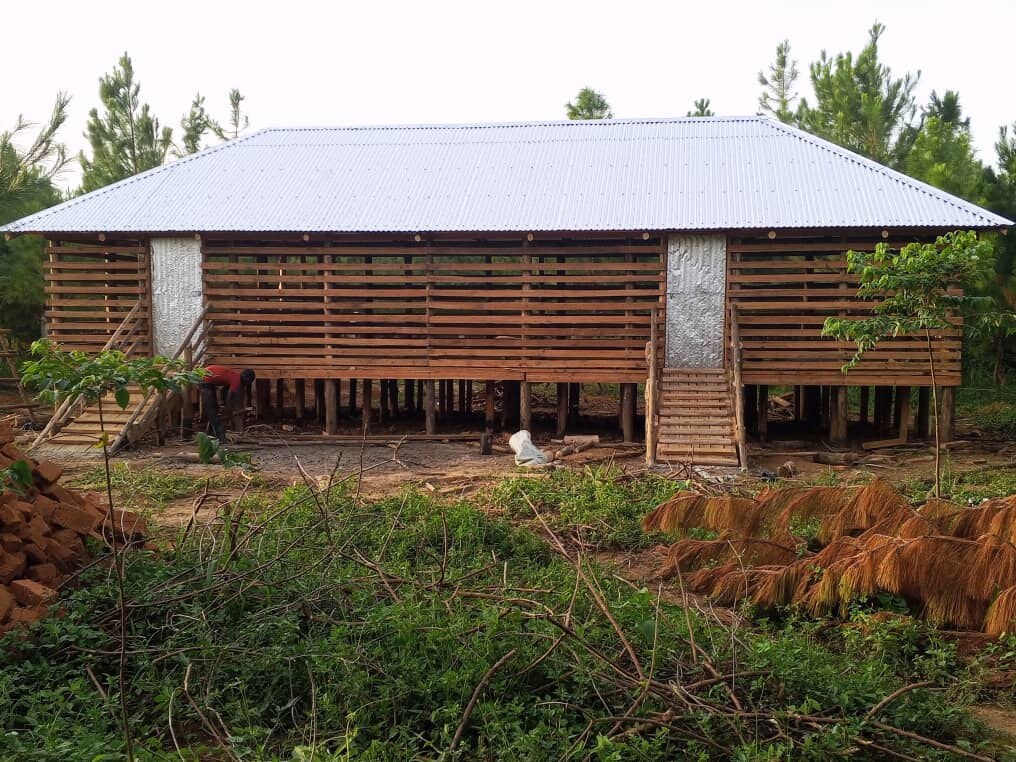
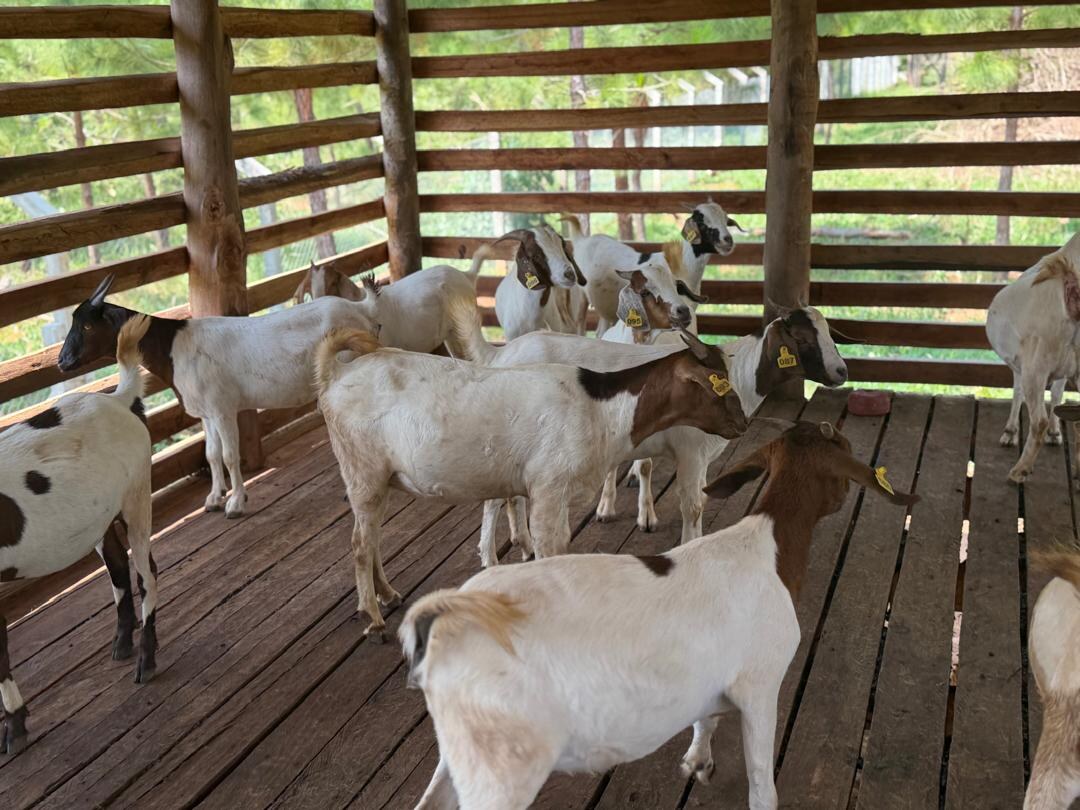
Jerusalem Goat Housing — Built and In Use
These are the actual Jerusalem goat-house facilities behind the capacity and construction-cost assumptions used in this plan.
Jerusalem · Amolatar, Uganda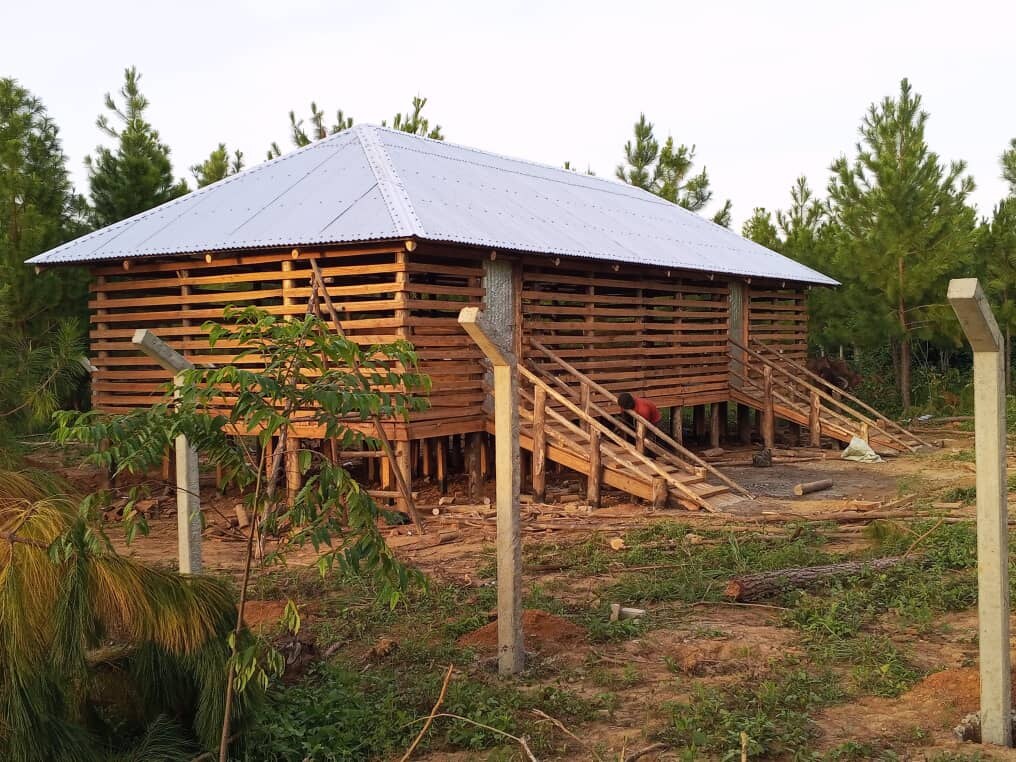
Why Jerusalem Needs More Housing
The revised plan uses the adult portion of each building, recognized Extension guidance and a conservative operating limit.
What the Existing 45 ft × 17 ft House Contains
| Total raised structure | 765 sq. ft. |
| Approximate adult section: 33–35 ft × 17 ft | 561–595 sq. ft. |
| Approximate kid/kidding section: 10–12 ft × 17 ft | 170–204 sq. ft. |
The kid/kidding section cannot also be counted as permanent adult-doe capacity. Feeders, water, handling space, pregnant animals and retained young females also reduce usable group space.
University Extension Planning References
Cornell describes 12–15 sq. ft. of shelter per doe when an exercise yard is available. New Mexico State describes 10–15 sq. ft. of bedded adult space plus 25 sq. ft. of exercise space, with separate kidding pens of at least 4 ft × 5 ft.
Jerusalem therefore plans only 30–32 productive adult does per existing-size house. This is deliberately below the raw floor-area maximum and does not replace local veterinary or construction review.
Separate Male Housing Is Also Required
This is a separate management facility and is not one of the seven Jerusalem doe-and-kid houses.
Rural concept · local design review requiredWhy It Is Needed
Oklahoma State's planning rule of one buck per 25–35 does suggests approximately 6–8 breeding bucks at 197 productive does. Missouri Extension recommends separate buck housing, and Mississippi State advises separating buck kids from does at about 2–4 months to prevent premature breeding.
The working concept provides 10 individual adult-buck stalls, separate male nursery and growout pens, and separated outdoor runs. Individual stalls reduce direct adult-buck contact and make controlled breeding easier; they do not remove the need for strong gates, daily inspection and competent animal management.
Planning Limits
The concept is based on the farm's affordable raised timber construction: wooden poles, elevated slatted wood floors, corrugated roofing and woven-wire runs.
The nursery and growout capacity must be checked against Jerusalem's actual kidding batches and male sale age. A local builder, livestock officer or veterinarian should approve the final dimensions, drainage, ventilation, feed access and handling route before construction.
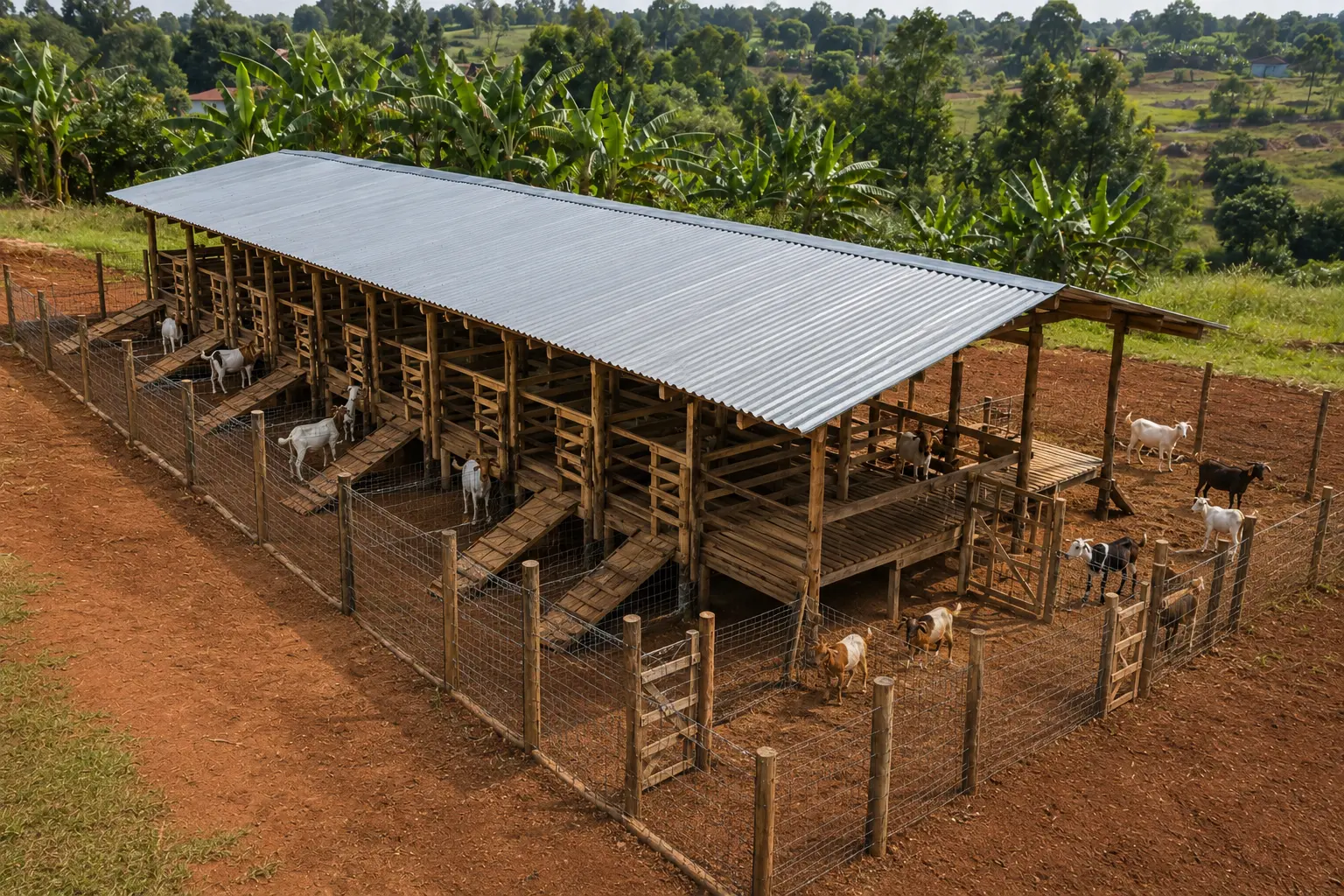
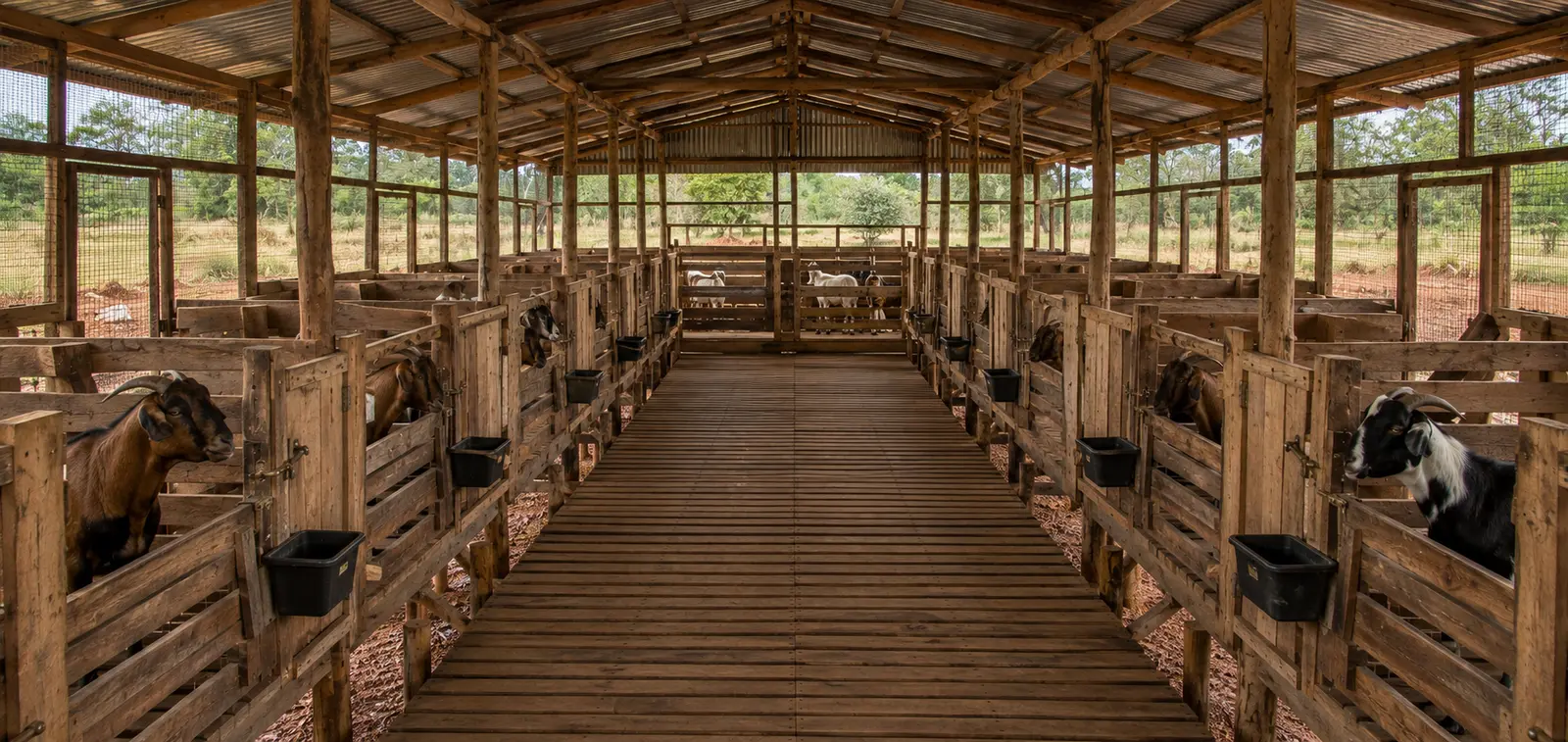
Concept images only: these are planning mockups, not architectural or engineering drawings.
Housing and Capital Plan
Housing follows Jerusalem herd growth rather than being built all at once. The separate male facility is budgeted only after a local quotation.
Current Benchmark
| Existing house footprint | 45 ft × 17 ft = 765 sq. ft. |
| Adult portion of each house | ~561–595 sq. ft. |
| Kid/kidding portion | ~170–204 sq. ft. |
| Jerusalem operating capacity | 30–32 adult does/house |
| Jerusalem doe houses | 7 total · 1 current · 6 additional |
| Six houses at historic $3,600 benchmark | $21,600.00 |
| Six houses at $4,500 planning reserve | $27,000.00 |
| Separate male facility | Local quote pending; excluded above |
Illustrative Growth Phase
A typical accelerated phase combines productive animals and the capacity to house them:
| 25 breeding females at $120.00 | $3,000.00 |
| One future goat house | $4,500.00 |
| Total illustrative phase | $7,500.00 |
| Equivalent goat sales at $85.00 | 89 goats |
How this phase can be financed: retain the best female offspring for herd growth, sell market-ready males, and apply Jerusalem's available net sale proceeds toward the next housing phase. If the house must be started before those sales are realized, BFC can bridge the timing gap. As Jerusalem grows, the farm should finance an increasing share of each new house until BFC bridge funding is no longer routinely needed.
| Jerusalem Breeding Does | House Equivalents | Additional Houses | Future Budget |
|---|---|---|---|
| 30–32 | 1 | Current Jerusalem house | Already built |
| 60–64 | 2 | +1 total | $4,500.00 |
| 90–96 | 3 | +2 total | $9,000.00 |
| 120–128 | 4 | +3 total | $13,500.00 |
| 150–160 | 5 | +4 total | $18,000.00 |
| 180–192 | 6 | +5 total | $22,500.00 |
| 210–224 | 7 | +6 total | $27,000.00 |
Investment Discipline and Measurement
This plan is designed to improve accountability, not promise a guaranteed outcome.
Track births per productive doe, male/female births, mortality, retained replacements and age at first breeding.
Track actual sale age, sale weight when practical, realized selling price and sale-related transport costs.
Do not purchase females without confirming housing, grazing, dry-season feed, health care and staffing capacity.
The August 22, 2026 assumptions remain preserved. A new timestamped plan should be appended after approximately six months of actual data.
Help Jerusalem build the next stage
Our goal is not permanent dependence on outside gifts. Jerusalem will retain the best females needed for herd growth, sell market-ready males and surplus animals, and reinvest farm-generated proceeds into future housing and productive capacity. Early in the climb, however, the herd is not yet large enough to finance every expansion step on its own. A cash gift toward goat housing or other productive infrastructure can shorten that gap without forcing the farm to sell the females needed to reach self-sufficiency.
The intent is for farm-generated income to fund an increasing share of each future expansion phase, reducing the amount that must be raised externally.
Farm Property Overview
Satellite view of the farm property and the outlined planning areas in Amolatar, Uganda.
Property planning image